

Quantum computing is a rapidly growing field that has the potential to revolutionize many areas of science, engineering, and technology. Here are some of the key areas of quantum computing:
- Quantum Algorithms: Quantum algorithms are specific algorithms designed to run on quantum computers, taking advantage of their unique properties. These algorithms can perform certain calculations much faster than classical algorithms, such as factoring large numbers and searching large databases.
- QuantumCryptography: Quantum cryptography is a method of secure communication that uses quantum mechanics to establish a secure communication channel between two parties. Quantum cryptography can provide stronger security than classical cryptography, as the act of measuring a quantum state alters that state, making any eavesdropping attempt detectable.
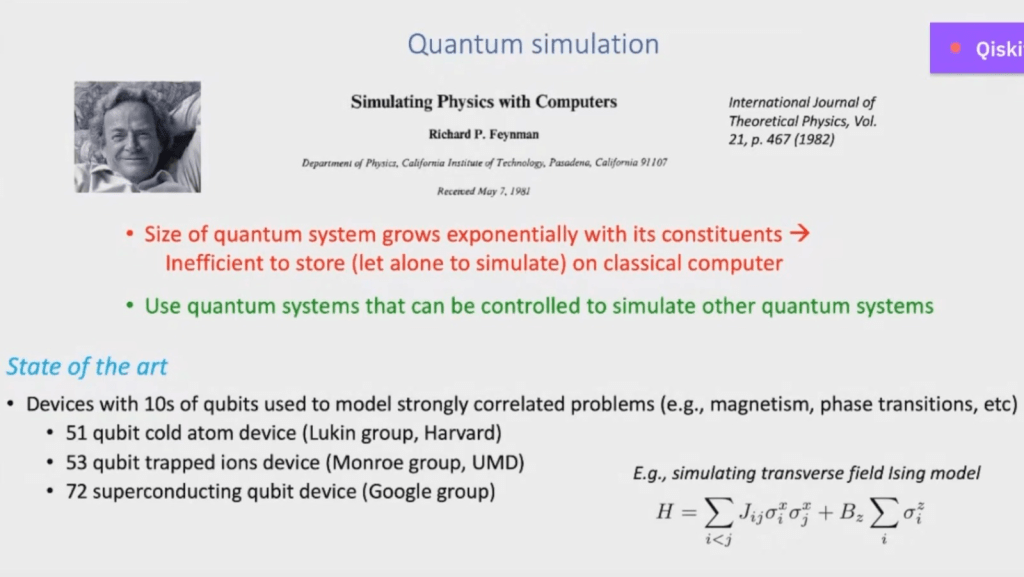
- Quantum Simulation: Quantum simulation involves using quantum computers to simulate quantum systems, which is useful for understanding the behavior of materials and chemical processes. Quantum simulation can help scientists and engineers design more efficient solar cells, better batteries, and new materials with unique properties.
- Quantum Machine Learning: Quantum machine learning is a subfield of quantum computing that investigates how to use quantum computers to perform machine learning tasks more efficiently. Quantum machine learning can help improve tasks such as image and speech recognition, natural language processing, and predictive modeling.
- Quantum Optimization: Quantum optimization is a subfield of quantum computing that investigates how to use quantum computers to solve optimization problems more efficiently. Quantum optimization can help optimize complex systems such as transportation networks, energy grids, and financial portfolios.
- Quantum Sensing: Quantum sensing involves using quantum effects to measure physical quantities such as magnetic fields, electric fields, and temperature with high precision. Quantum sensing can be used in a variety of applications, such as medical imaging, mineral exploration, and navigation.
- Quantum Error Correction: Quantum error correction is a crucial component of quantum computing, as quantum systems are highly susceptible to errors. Quantum error correction involves the use of quantum codes, which can protectquantum information against errors caused by noise and other disturbances. Quantum error correction is necessary for building large-scale, fault-tolerant quantum computers.
- Quantum Cryptanalysis: Quantum cryptanalysis is the study of how quantum computers can be used to break classical cryptographic systems. While quantum computing has the potential to make some classical cryptographic systems vulnerable, quantum cryptanalysis can be used to develop new cryptographic systems that are resistant to quantum attacks.
- Quantum Communication: Quantum communication involves the transmission of information using quantum states, which allows for secure communication that cannot be intercepted without detection. Quantum communication includes both quantum key distribution and quantum teleportation, and has the potential to provide secure communication channels for a range of applications.
- Quantum Hardware: Quantum hardware is the physical devices that implement quantum computing, such as superconducting qubits, trapped ions, and topological qubits. Quantum hardware is essential for building large-scale, fault-tolerant quantum computers and for testing and demonstrating new quantum algorithms and applications.
These are the key areas of quantum computing. The following articles will delve into details each of the area to explore the future of Quantum.
Key Quantum Algorithms along with their relevant academic papers:
- Shor’s Algorithm: Shor’s algorithm is a quantum algorithm for factoring large numbers. It was developed by Peter Shor in 1994 and is one of the most famous quantum algorithms. The original paper is titled “Algorithms for quantum computation: discrete logarithms and factoring” by Peter W. Shor (1994).
- Grover’s Algorithm: Grover’s algorithm is a quantum algorithm for searching unsorted databases. It was developed by Lov Grover in 1996 and can search an unsorted database of N items in O(sqrt(N)) time. The original paper is titled “A fast quantum mechanical algorithm for database search” by Lov K. Grover (1996).
- Quantum Fourier Transform (QFT): The quantum Fourier transform is a quantum version of the classical Fourier transform, which is used to analyze the frequency components of signals. The QFT is a crucial component of many quantum algorithms, including Shor’s algorithm. The original paper is titled “Efficient quantum algorithms for simulating sparse Hamiltonians” by Andrew M. Childs et al. (2004).
- Quantum Phase Estimation: Quantum phase estimation is a quantum algorithm that allows for the estimation of the eigenvalues of a unitary operator. It is a crucial component of many quantum algorithms, including Shor’s algorithm and the quantum simulation of quantum chemistry. The original paper is titled “Quantum phase estimation algorithm” by Kitaev et al. (1995).
- HHL Algorithm: The HHL algorithm is a quantum algorithm for solving linear systems of equations. It was developed by Harrow, Hassidim, and Lloyd in 2009 and has the potential to provide exponential speedup over classical algorithms for certain types of problems. The original paper is titled “Quantum algorithm for solving linear systems of equations” by Aram W. Harrow, Avinatan Hassidim, and Seth Lloyd (2009).
- Quantum Approximate Optimization Algorithm (QAOA): QAOA is a quantum algorithm for solving optimization problems, such as those encountered in machine learning and artificial intelligence. It was developed by Farhi et al. in 2014 and has the potential to provide exponential speedup over classical algorithms for certain types of problems. The original paper is titled “A Quantum Approximate Optimization Algorithm” by Edward Farhi, Jeffrey Goldstone, and Sam Gutmann (2014).
- Quantum Walks: Quantum walks are quantum versions of classical random walks, which are used to simulate complex systems and to search unsorted databases. Quantum walks have been shown to provide exponential speedup over classical random walks for certain types of problems. The original paper is titled “Quantum walks” by Venegas-Andraca (2012).
- Quantum Principal Component Analysis (PCA): Quantum PCA is a quantum algorithm for principal component analysis, which isa technique used in machine learning and data analysis to reduce the dimensionality of data. It was developed by Lloyd et al. in 2013 and has the potential to provide exponential speedup over classical algorithms for certain types of problems. The original paper is titled “Quantum principal component analysis” by Seth Lloyd, Masoud Mohseni, and Patrick Rebentrost (2013).
- Quantum Amplitude Amplification: Quantum amplitude amplification is a quantum algorithm that allows for the amplification of a specific amplitude in a quantum state. It has applications in quantum search algorithms, quantum simulation, and quantum machine learning. The original paper is titled “Quantum Amplitude Amplification and Estimation” by Brassard et al. (2000).
- Quantum Approximate Counting: Quantum approximate counting is a quantum algorithm that allows for the estimation of the number of solutions to a Boolean formula. It has applications in cryptography, optimization, and machine learning. The original paper is titled “Quantum approximate counting” by Brassard et al. (1998).
Some more Quantum Algorithms and resources worth noticing:
A. Quantum Annealing
B. Quantum Monte Carlo
C. Variational Quantum Eigensolvers
D. Quantum Simulation
Applications of Quantum Algorithms
Knowing the names of the Quantum algorithms is not helpful without understanding their wide range of applications. They have big impact in multiple fields, from cryptography and optimization to machine learning and finance. Here are some examples of how quantum algorithms can be applied in real-world use cases:
- Cryptography: Quantum algorithms have the potential to break classical cryptographic systems, but they can also be used to develop new quantum-safe cryptographic systems. For example, Shor’s algorithm can be used to factor large numbers, which is the basis for many cryptographic systems. By breaking these systems, Shor’s algorithm can make them vulnerable to attacks. However, quantum cryptography based on quantum key distribution (QKD) can provide secure communication channels that are resistant to eavesdropping.
- Optimization: Quantum optimization algorithms, such as the Quantum Approximate Optimization Algorithm (QAOA), can be used to optimize complex systems such as transportation networks, energy grids, and financial portfolios. QAOA has been shown to provide exponential speedup over classical algorithms for certain types of optimization problems, making it a promising tool for solving large-scale optimization problems.
- Machine Learning: Quantum machine learning algorithms, such as Quantum Principal Component Analysis (PCA), can be used to perform tasks such as image and speech recognition, natural language processing, and predictive modeling. Quantum machine learning can help improve the accuracy and efficiency of machine learning algorithms and can help solve problems that are currently intractable for classical computers.
- Chemistry: Quantum algorithms can be used to simulate the behavior of molecules and chemical reactions, which isuseful for drug discovery and materials science. For example, the Variational Quantum Eigensolver (VQE) algorithm can be used to calculate the properties of molecules, which can help in the development of new drugs and materials.
- Finance: Quantum algorithms can be used in finance for tasks such as portfolio optimization, risk analysis, and option pricing. For example, the Quantum Monte Carlo (QMC) algorithm can be used to simulate financial systems and risk analysis, while the HHL algorithm can be used to solve linear systems of equations, which is useful for pricing financial derivatives.
- Supply Chain Management: Quantum algorithms can be used in supply chain management to optimize logistics and minimize waste. For example, the Quantum Approximate Optimization Algorithm (QAOA) can be used to optimize the routing of goods and minimize transportation costs.
- Energy: Quantum algorithms can be used in energy management to optimize energy grids and reduce energy waste. For example, the Quantum Approximate Optimization Algorithm (QAOA) can be used to optimize the placement of renewable energy sources such as wind turbines and solar panels, minimizing the cost of energy production and reducing carbon emissions.
- Traffic Optimization: Quantum algorithms can be used to optimize traffic flow in urban areas, reducing congestion and improving transportation efficiency. For example, the Quantum Approximate Optimization Algorithm (QAOA) can be used to optimize traffic signal timings, minimizing wait times and reducing travel times for commuters.
- Climate Modeling: Quantum algorithms can be used to simulate the behavior of the Earth’s climate, which is useful for understanding the effects of climate change and for developing strategies to mitigate its impact. For example, the Variational Quantum Eigensolver (VQE) algorithm can be used to calculate the properties of molecules involved in climate change, such as carbon dioxide and methane.
- Quantum Machine Vision: Quantum algorithms can be used to improve the accuracy and efficiency of machine vision algorithms, which are used in applications such as self-driving cars and robotics. For example, the Quantum Support Vector Machine (QSVM) algorithm can be used to classify images and identify objects more accurately and efficiently than classical machine learning algorithms.
- Quantum Internet: Quantum algorithms can be used in the development of a quantum internet, which is a network that uses quantum communication to transmit information securely. For example, quantum key distribution (QKD) can be used to establish secure communication channels between parties, while quantum teleportation can be used to transmit quantum information over long distances.
- Logistics: Quantum algorithms can be used to optimize logistics andsupply chain management, reducing waste and improving efficiency. For example, the Quantum Approximate Optimization Algorithm (QAOA) can be used to optimize the routing of goods and minimize transportation costs, while the Quantum Annealing-based Integer Programming (QAIP) algorithm can be used to solve complex logistics problems.
- Data Analysis: Quantum algorithms can be used to analyze large datasets, identifying patterns and extracting useful information. For example, the Quantum Principal Component Analysis (PCA) algorithm can be used to reduce the dimensionality of large datasets, making them easier to analyze and process.
- Materials Science: Quantum algorithms can be used to simulate the behavior of materials and to design new materials with unique properties. For example, the Variational Quantum Eigensolver (VQE) algorithm can be used to calculate the properties of materials, while the Quantum Annealing-based Integer Programming (QAIP) algorithm can be used to optimize the design of new materials.
- Aerospace: Quantum algorithms can be used in aerospace engineering to optimize the design of aircraft and spacecraft, reducing weight and improving efficiency. For example, the Quantum Annealing-based Integer Programming (QAIP) algorithm can be used to optimize the placement of components in an aircraft or spacecraft, minimizing weight and reducing fuel consumption.
These are just a few examples of how quantum algorithms can be applied in real-world use cases. Ongoing research in the field is focused on developing new quantum algorithms and improving the efficiency and practicality of quantum computing, with the goal of making it a viable option for solving a wide range of complex problems in the future.
Quantum Use Cases:
- Quantum Cryptography: Quantum cryptography is a secure communication method that uses quantum mechanics to generate and distribute cryptographic keys. One of the seminal papers in this field is “Quantum Cryptography: Public Key Distribution and Coin Tossing” by Charles H. Bennett and Gilles Brassard (1984).
- Quantum Machine Learning: Quantum machine learning is a subfield of quantum computing that investigates how to use quantum computers to perform machine learning tasks more efficiently. One of the influential papers in this field is “Supervised Learning with Quantum Computers” by Maria Schuld, Francesco Petruccione, and Isaac L. Chuang (2018).
- Quantum Chemistry: Quantum computers have the potential to revolutionize the field of quantum chemistry by allowing for the simulation of complex chemical reactions and materials. One of the pioneering papers in this field is “Simulating Chemistry using Quantum Computers” by Alán Aspuru-Guzik et al. (2012).
- Quantum Optimization: Quantum optimization is a subfield of quantum computing that investigates how to use quantum computers to solve optimization problems more efficiently. One of the significant papers in this field is “Quantum annealing with manufactured spins” by D-Wave Systems Inc. (2011).
- Quantum Simulation: Quantum simulation is the use of quantum computers to simulate quantum systems, which is useful for understanding the behavior of materials and chemical processes. One of the fundamental papersin this field is “Digital Quantum Simulation of Spin Models with Circuit Quantum Electrodynamics” by Andreas Mezzacapo et al. (2018).
- Quantum Communication: Quantum communication involves the transmission of information using quantum states, which allows for secure communication that cannot be intercepted without detection. One of the pioneering papers in this field is “Experimental Quantum Cryptography” by Artur Ekert (1991).
- Quantum Error Correction: Quantum error correction is a crucial component of quantum computing, as quantum systems are highly susceptible to errors. One of the influential papers in this field is “Stabilizer Codes and Quantum Error Correction” by Daniel Gottesman (1997).
- Quantum Sensing: Quantum sensing involves using quantum effects to measure physical quantities such as magnetic fields, electric fields, and temperature with high precision. One of the significant papers in this field is “Quantum sensing” by Lloyd et al. (2011).
- Quantum Key Distribution: Quantum key distribution is a method of secure communication that uses quantum mechanics to transmit keys. One of the seminal papers in this field is “Experimental Quantum Cryptography” by Artur Ekert (1991).
- Quantum Computing Algorithms: Quantum computing algorithms are specific algorithms designed to run on quantum computers, taking advantage of their unique properties. One of the influential papers in this field is “Quantum Algorithms for Linear Algebra and Machine Learning” by Seth Lloyd et al. (2013).
 DATAWARD